The requirements for modern optical fiber ribbons continue to increase. In addition to high fiber density and easy fiber separation, mechanical stability and robustness are becoming increasingly important. With our IGF Intermittent Ribbon Bonding Line, we offer a technology that not only enables a wide variety of individual bonding patterns but also expands the available configuration options for the final product. This capability is based on our highly precise intermittent bonding process for optical fiber ribbons using freely configurable bonding patterns.
Even Greater Flexibility in Product Design
For applications requiring enhanced stability, the IGF offers an additional option: instead of applying bonds on only one side of the intermittent ribbon, bonds can also be applied on the opposite side, resulting in bonding on both the top and bottom surfaces. The bonding application on the bottom side can be performed simultaneously with the application on the top side or in a separate process step.
There are various configuration options available. The bond positions on the bottom side can either correspond exactly to the positions on the top side or be intentionally offset. This allows the structure of the intermittent ribbon to be precisely tailored to the specific application, enabling more flexible and customized bonding geometries.
Increased Structural Stability Through Extended Bonding Structures
Dual-sided bonding enables additional bonds that can be strategically implemented to further increase ribbon stability and provide improved connection reliability between the individual fibers.
Particularly in applications with enhanced mechanical requirements, the additional bonding layer on the bottom side creates a more comprehensive connection between the individual fibers. The result is a more robust intermittent ribbon while maintaining the advantages of intermittent bonding technology.
Improved Mechanical Properties
Another advantage of dual-sided bonding is the optimized load distribution within the ribbon structure. Forces can be absorbed and distributed more evenly across the bonding structure, increasing the mechanical robustness of the product. At the same time, the higher structural stability improves handling and processing behavior.
Flexible Combination of Bonding Materials
In addition to bonding geometry, the selection of the bonding material plays a crucial role in determining the properties of an intermittent ribbon. As an experienced development partner to the cable industry, we therefore focus not only on the mechanical and optical configuration of the final product but also on the optimal interaction between bonding materials and application processes.
Depending on the application requirements, different bonding characteristics may be prioritized. These include water-blocking properties to protect against moisture ingress, defined adhesion characteristics that enable easy, residue-free, damage-free fiber separation during further processing, or particularly robust bonds for increased mechanical performance. Accordingly, permanently adhesive or selectively removable bonding materials, as well as materials with specific functional properties, can be used.
Thanks to the flexibility of the IGF production process, multiple bonding materials can also be combined within a single intermittent ribbon. For example, one bonding material may be applied on the top side and a different material on the bottom side. Furthermore, different materials can be applied alternately on both the top and bottom sides. This enables the targeted combination of different material properties within defined intermittent ribbon sections and allows the product to be optimally adapted to the intended application.
Technology for Application-Specific Solutions
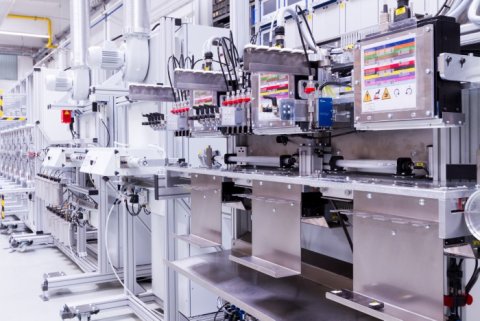
The IGF has been developed to provide maximum flexibility in the configuration of intermittent ribbons. Variable bond lengths, different bonding geometries and freely definable bonding patterns are already standard features. The option of dual-sided bonding adds another dimension to this flexibility and, together with the flexible selection of bonding materials, enables the targeted optimization of structural stability, mechanical robustness and functional product properties.
Our platform once again demonstrates its capabilities in highly precise, application-specific optical fiber ribbon production – ranging from standard products to customized high-performance intermittent ribbon solutions.